
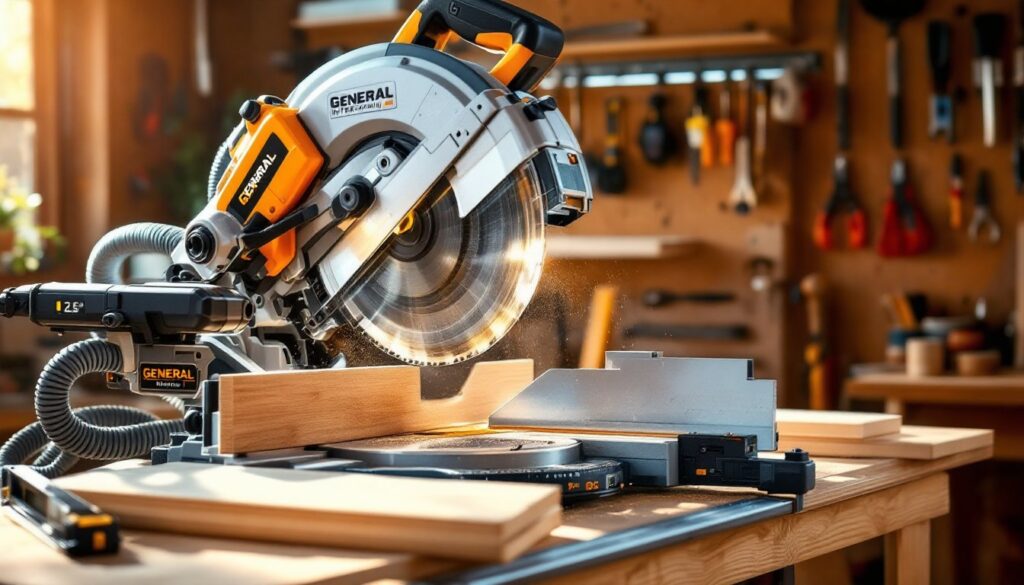
General International has carved out a reputation among serious DIYers and woodworking professionals who want accurate cuts without the premium price tag of big-name brands. Their miter saws balance precision engineering with mid-range pricing, making them a solid option for workshops that demand repeatable accuracy on trim, framing, and furniture projects. This guide breaks down what sets General International apart, examines key features across their lineup, compares popular models, and walks through maintenance practices that keep these saws running true for years.
Key Takeaways
- General International miter saws balance precision engineering with mid-range pricing, making them ideal for DIYers and professionals who demand accuracy without premium brand costs.
- Dual-bevel capability, LED work lights, and extended sliding capacity (12–14 inches depending on model) are standard features that rival more expensive competitors in this tool category.
- A General International miter saw requires minor out-of-box calibration and delivers cut-length repeatability within 1/32″ on production runs, suitable for professional trim installation.
- Proper maintenance—including blade cleaning every 10–15 hours, rail lubrication with dry PTFE lubricant, and regular fence alignment checks—keeps these saws running true for years.
- The 10″ sliding dual-bevel model ($350–$450) suits trim carpenters and finish work, while the 12″ sliding compound saw ($475–$600) handles wider stock like deck framing and stair treads.
- Dust collection captures 75–80% of sawdust at the source when paired with a 6.5-peak-HP or larger shop vac, significantly outperforming many mid-range competitors.
What Makes General International Miter Saw Stand Out
General International positions itself between budget import brands and premium North American manufacturers. The company focuses on precision metalwork, most models feature laser-cut steel bases and rigid aluminum fences that resist warping under load. This attention to structural integrity translates to less calibration drift over time.
Their saws often include features typically reserved for higher-priced competitors: dual-bevel capability, LED work lights, and extended sliding capacity on 10″ and 12″ models. The miter detent system uses positive stops at common angles (0°, 15°, 22.5°, 31.6°, 45°) with easy override for custom angles, a practical design that speeds up repetitive cuts without sacrificing flexibility.
General International also builds in above-average dust collection. Their shrouds connect to standard 2.5″ shop vac hoses and capture roughly 75–80% of sawdust at the source when paired with adequate suction. That’s measurably better than many competitors in the same price bracket, which matters for both shop cleanliness and respiratory health.
Key Features of General International Miter Saws
Motor power ranges from 15-amp motors on their 10″ models to robust 15-amp motors on 12″ sliding compound versions. These deliver sufficient torque for crosscutting hardwoods like oak or maple, though users should feed stock steadily rather than forcing cuts to avoid bogging down the blade.
Sliding rails on compound models extend crosscut capacity to 12–14″ depending on the model, handling standard dimensional lumber and wider stock like 2×12 boards (actual 1.5″ × 11.25″) without repositioning. The rails use linear ball bearings that resist side-to-side play, critical for maintaining square cuts on crown molding or picture frames.
Bevel range on dual-bevel models tilts 0–48° left and right, with positive stops at 0°, 33.9° (for crown molding spring angle), and 45°. The bevel lock lever is accessible from the front, so operators don’t need to reach behind the motor housing during adjustments.
Blade visibility gets a boost from integrated LED work lights that illuminate the cut line without the shadows cast by overhead shop lighting. Some models include laser guides, though experienced users often find these less useful than a clean sightline to the blade tooth itself.
Table extensions fold out to support longer stock, and most models include adjustable material stops for repeatable cut lengths, essential for production runs of trim or deck boards.
Popular General International Miter Saw Models Compared
The 10″ sliding dual-bevel model serves as the sweet spot for trim carpenters and finish work. It handles baseboards, door casings, and crown molding with a 12″ crosscut capacity at 90° and roughly 8.5″ at 45°. Weight hovers around 45–50 lbs, making it portable enough for job sites but stable during operation. Expect to pay mid-tier pricing, typically in the $350–$450 range depending on retail promotions.
The 12″ sliding compound saw steps up crosscut capacity to 14″ at 90° and approximately 10″ at 45°, which accommodates stair treads, wider shelving, and deck framing. The larger blade also maintains higher peripheral speed on thick hardwoods. Weight increases to 60–65 lbs, so this model suits dedicated workshop installations more than frequent transport. Pricing generally runs $475–$600.
For users who don’t need sliding capacity, General International offers non-sliding 10″ and 12″ models that sacrifice crosscut width but gain compactness and lower weight. These work well for angle-cutting narrower stock like quarter-round, lattice, or small craft projects. They’re also easier to mount on fold-down workbenches or mobile tool carts.
All models accept standard carbide-tipped blades with 5/8″ arbors. A 60-tooth or 80-tooth blade produces smoother cuts on finished trim, while a 40-tooth blade clears waste faster on framing lumber.
Who Should Consider a General International Miter Saw
Trim carpenters and finish professionals appreciate the repeatable accuracy and dual-bevel convenience on crown molding, where both miter and bevel adjustments happen frequently. The saw’s positive detent stops and smooth bevel action reduce setup time on multi-room installations.
Home workshop owners tackling weekend projects, deck builds, furniture making, or room renovations, get professional-grade cuts without industrial pricing. The balance of features to cost makes sense for users who’ll log hundreds of cuts per year but don’t need the extreme duty cycle of a contractor running production jobs.
DIYers upgrading from basic chop saws will notice immediate improvements in cut quality and versatility. The ability to bevel in both directions and slide through wider stock opens up project possibilities that single-bevel or non-sliding models can’t handle efficiently.
General International may not suit users needing ultra-portable jobsite saws with built-in rolling stands and quick-release brackets. These saws favor workshop stability over mobility. Similarly, production shops running continuous eight-hour days might prefer industrial brands engineered for extreme duty cycles, though General International holds up well under typical professional use.
Performance and Accuracy: What to Expect
Out-of-box calibration on General International saws typically requires minor tuning. Users should verify miter and bevel angles with a quality square, a machinist’s combination square or digital angle gauge works well. The 0° miter stop usually lands within 0.1–0.2° of true, which is tight enough for most trim work. The fence should sit 90° to the table: shim with aluminum tape if adjustment screws don’t dial it in perfectly.
Crosscut capacity matches published specs when the blade is sharp and properly aligned. Dull blades or excessive side pressure during cuts can cause the motor to bog or the workpiece to shift, ruining accuracy. Feed stock smoothly and let the blade do the work, forcing cuts generates heat, burns edges, and accelerates blade wear.
Repeatability shines on production cuts. Once the saw is dialed in and the material stop is set, users can expect cut-length variance under 1/32″ across dozens of pieces, sufficient for professional trim installation where coped joints and tight miters matter.
Dust collection performance depends heavily on shop vac CFM. A 6.5-peak-HP or larger shop vac maintains enough suction to capture most dust. Smaller vacuums struggle to keep up during continuous cutting. Always wear a dust mask or respirator when cutting treated lumber, MDF, or any material that produces fine particulates, even good dust collection isn’t 100% effective.
Maintenance Tips for Longevity and Optimal Performance
Blade care extends saw performance significantly. Remove pitch and resin buildup every 10–15 hours of cutting using a dedicated blade cleaner or a soak in Simple Green. Inspect carbide teeth for chips: a single damaged tooth throws the blade out of balance and degrades cut quality. Sharpen or replace blades when cuts start burning wood or requiring extra feed pressure.
Lubrication keeps sliding rails smooth. Wipe the rails clean with a dry cloth, then apply a thin coat of dry PTFE lubricant or paste wax, avoid wet oils that attract sawdust. Lubricate the bevel pivot points and miter lock mechanism annually or whenever movement feels stiff.
Fence and table alignment should be checked every few months or after any saw relocation. Loosen the fence bolts, square it to the blade with a framing square, then retighten. Verify the table insert (throat plate) sits flush with the table surface: a raised insert catches workpieces and ruins cuts.
Carbon brush inspection applies to all miter saw motors. Most General International models use brushed universal motors. Brushes wear over time and should be replaced when they’re down to 1/4″ length. Consult the manual for access points, typically behind removable caps on the motor housing.
Dust port cleaning prevents clogs that reduce collection efficiency. Disconnect the hose and clear packed sawdust from the shroud and port opening after heavy cutting sessions, especially when working with resinous softwoods like pine or cedar.
Safety gear isn’t optional. Wear safety glasses, hearing protection, and a dust mask on every cut. Miter saws throw debris and generate noise levels above 95 dB, which causes hearing damage with repeated exposure.
Conclusion
General International miter saws deliver the accuracy and feature set serious DIYers and professionals expect, without the premium pricing of top-tier brands. Their rigid construction, dual-bevel capability, and effective dust collection make them competitive tools for trim carpentry, furniture building, and general workshop use. With proper setup, regular maintenance, and sharp blades, these saws produce clean, repeatable cuts that hold up on projects where precision matters.