
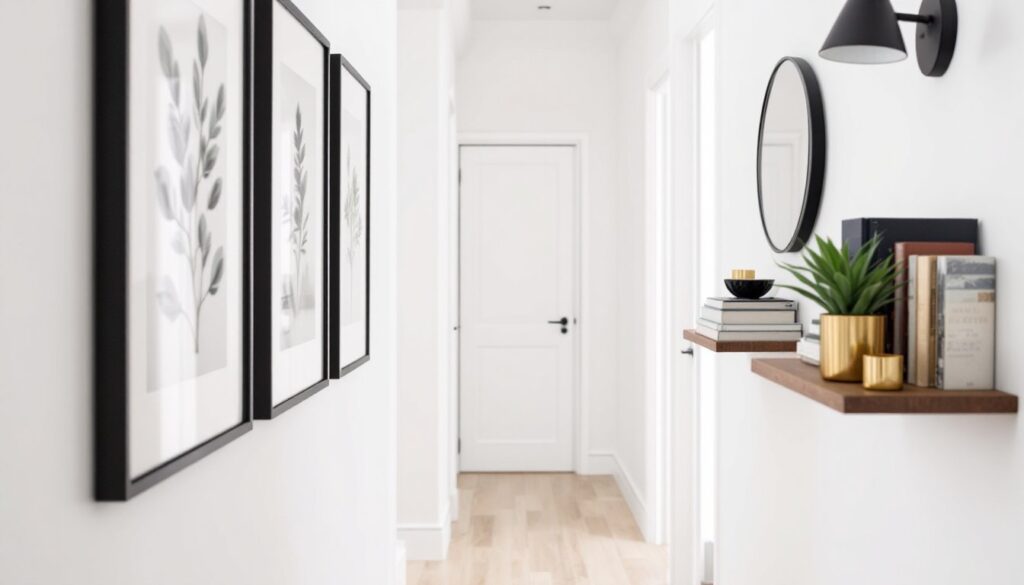
Narrow hallways often become forgotten corridors, functional pass-throughs that homeowners ignore until they’re staring down a claustrophobic, builder-beige tunnel every day. But these tight spaces offer surprising potential for visual impact with the right wall decor strategy. Unlike wide, open rooms where décor competes for attention, hallways force focus. Every piece matters. Strategic wall treatments can make a 36-inch-wide passage feel taller, brighter, and more intentional without adding square footage or knocking down walls. The trick lies in working with the proportions, not against them, using vertical lines, reflective surfaces, and scaled-down arrangements that avoid visual clutter.
Key Takeaways
- Narrow hallway wall decor should prioritize vertical arrangements and proportions, using portrait-oriented art, stacked frames, and tall panels to counter the tunnel effect and draw the eye upward.
- Mirrors are the most effective optical trick for tight hallways, instantly brightening spaces and creating the illusion of width when positioned opposite light sources.
- Gallery walls work best in slim corridors as single-line arrangements with frames of equal height, spaced 3-4 inches apart, keeping the overall display to two-thirds of wall width.
- Functional decor like floating shelves (6-8 inches deep), peg rails, and slim-profile sconces add visual interest and storage without protruding more than 2 inches into the walking path.
- Bold wallpaper with vertical stripes and saturated paint colors (navy, charcoal, deep green) make narrow hallways feel intentional rather than cramped, especially when contrasted with bright white trim.
- Proper preparation and secure anchoring of all wall décor into studs or heavy-duty anchors prevents safety hazards and ensures pieces withstand wear in high-traffic hallway spaces.
Why Narrow Hallways Need Strategic Wall Decor
Most hallways measure 36 to 42 inches wide, just enough clearance to meet IRC minimum egress requirements but tight enough that standard decorating rules fall flat. Hang a large horizontal canvas in a slim corridor and it shrinks the space visually, boxing in the walls. Overcrowd with décor and the hallway feels like a cluttered antique shop.
Narrow spaces amplify proportion mistakes. A gallery wall that works beautifully in a living room can overwhelm when confined between two close walls. Conversely, leaving walls bare makes the hallway feel institutional, more apartment complex than intentional home design.
Wall decor in tight hallways serves three purposes: it draws the eye vertically to counter the narrow width, adds visual interest without physical depth, and defines the space as deliberate rather than leftover. Mirrors bounce light and create the illusion of width. Vertical arrangements elongate sightlines. Slim shelving adds function without eating into walking clearance.
The goal isn’t to disguise the hallway’s narrowness but to make it feel curated. Homeowners should measure wall width and ceiling height before selecting pieces. A 60-inch-tall vertical piece works better than a wide landscape print. Keep protrusion in mind, anything extending more than 2 inches from the wall risks catching shoulders, bags, or laundry baskets.
Vertical Art Arrangements That Draw the Eye Upward
Vertical compositions counteract the tunnel effect by pulling focus toward the ceiling. Instead of hanging a single wide piece, stack two or three smaller frames in a column. Portrait-oriented canvases (16×20, 18×24, or 20×30 inches) work better than landscape formats in hallways under 42 inches wide.
For renters or those avoiding multiple nail holes, picture rails or gallery hanging systems offer flexibility. A simple rail mounted 10 to 12 inches below the ceiling lets homeowners swap art using cables and hooks without fresh drywall repairs. These systems also allow precise vertical spacing, 6 to 8 inches between frames prevents pieces from blending together visually.
Long vertical panels, such as reclaimed wood boards or framed fabric, add height drama without heavy visual weight. A single 12-inch-wide by 72-inch-tall panel draws the eye up and introduces texture. Diptychs and triptychs arranged vertically create rhythm down the hallway’s length.
When hanging art in a narrow hallway, position pieces at eye level (57 to 60 inches to center), the same guideline used in galleries. But in tight quarters, err slightly higher if ceiling height allows. This tricks the brain into perceiving more vertical space. Keep frame depth minimal: ½-inch to 1-inch profiles avoid protruding into the walking path.
Mirror Magic: Using Reflective Surfaces to Expand Narrow Spaces
Mirrors remain the most effective optical trick for tight hallways. Full-length mirrors (at least 48 inches tall) reflect natural or artificial light, instantly brightening dim corridors while visually doubling width. Position mirrors opposite windows or light sources to maximize bounce.
Leaning floor mirrors work if the hallway dead-ends and isn’t a high-traffic thoroughfare. A 24×72-inch leaning mirror propped at the end of a hallway creates depth without requiring wall anchors, though it must be secured with anti-tip straps in homes with children or pets.
For walls, opt for frameless or slim-profile mirrors to avoid chunky borders that crowd the space. Mirrored tiles arranged in vertical strips add Art Deco flair while preserving the upward visual pull. Standard 12×12-inch mirror tiles can be adhered with mirror mastic and arranged in staggered or grid patterns.
Avoid placing mirrors directly across from each other, this creates an infinite reflection loop that feels disorienting in a narrow passage. Instead, position one mirror on a single wall, ideally across from a textured or colorful surface to reflect something visually interesting. Safety note: Use tempered glass or acrylic mirrors in hallways near stairs or heavy-traffic zones to reduce shatter risk.
Gallery Walls Designed for Slim Corridors
Gallery walls can work in narrow hallways, but they require tighter editing than open-room versions. The key is linear arrangement, a single horizontal row of frames rather than a sprawling salon-style cluster.
Plan a single-line gallery with frames of equal height but varying widths. Align the top or bottom edges and space frames 3 to 4 inches apart. This creates visual movement down the hallway’s length without overwhelming the limited width. Keep the overall gallery no wider than two-thirds of the wall space to preserve breathing room.
Frame uniformity helps cohesion in tight quarters. Matching black, white, or natural wood frames create a clean line even when art styles vary. Mix photographs, prints, and small watercolors while keeping a consistent mat width, 2 to 3 inches provides enough border without shrinking the artwork.
For hallways with 8-foot ceilings, stick to 5 to 7 frames per wall to avoid clutter. Higher ceilings (9 or 10 feet) can handle more pieces or a stacked two-row arrangement. Use painter’s tape to mock up placement before hammering nails: this avoids multiple holes from trial and error.
Alternatively, install a picture ledge (a shallow floating shelf, typically 2 to 4 inches deep). Ledges let homeowners layer frames and swap pieces seasonally without new hardware. Mount ledges at 54 to 60 inches from the floor for easy viewing.
Functional Decor: Shelving, Hooks, and Wall-Mounted Storage
In narrow hallways, decor that doubles as storage maximizes utility without sacrificing style. Floating shelves (6 to 8 inches deep) hold small plants, books, or decorative objects without protruding into the walkway. Install shelves with hidden brackets or flush-mount hardware for a cleaner look.
Stagger shelf heights to create visual interest. Place one shelf at 48 inches, another at 66 inches, spacing them 18 to 24 inches apart vertically. Keep styling minimal, three to five small items per shelf prevents a cluttered appearance.
Wall-mounted hooks or peg rails add function while introducing material texture. Shaker peg rails in natural wood or painted finishes offer spots for bags, hats, or lightweight jackets. Mount rails 60 to 65 inches high for adult use, or lower for mudroom-style hallways near entryways.
Sconces serve as both lighting and decor. Swing-arm or slim-profile sconces (extending no more than 6 inches from the wall) illuminate artwork or provide ambient light without overhead glare. Hardwired sconces require electrical work and possibly a permit depending on local codes, but plug-in versions with cord covers offer easier installation.
Safety reminder: Any shelf or hook in a hallway must be anchored into studs or with appropriate drywall anchors rated for the load. Toggle bolts or heavy-duty anchors (rated for 50+ pounds) prevent shelves from ripping out under weight. Always wear safety glasses when drilling overhead.
Bold Wallpaper and Paint Techniques for Maximum Impact
Narrow hallways offer a low-risk testing ground for bold color and pattern. Since hallways are transitional spaces rather than long-stay rooms, homeowners can embrace dramatic choices they’d hesitate to use elsewhere.
Vertical stripe wallpaper amplifies height, especially stripes 3 to 6 inches wide in contrasting tones. Thin pinstripes can feel busy in tight quarters: wider stripes provide impact without visual noise. Peel-and-stick wallpaper works well for renters or commitment-phobes, though traditional paste wallpaper offers more pattern options and durability.
Dark or saturated paint colors, navy, charcoal, deep green, or terracotta, can make narrow hallways feel intentional rather than cramped, especially when ceilings and trim are painted in contrasting bright white. This creates crisp boundaries and draws attention to architectural details. One gallon of paint typically covers 350 to 400 square feet, enough for most standard hallways with a second coat.
Accent walls at hallway ends create focal points. Paint or wallpaper the short wall at the corridor’s terminus in a bold hue or graphic pattern to pull the eye forward and give the space a destination.
For a textured approach, consider board and batten, picture frame molding, or wainscoting. These treatments add depth and dimension without requiring artwork. Install wainscoting 32 to 36 inches high (roughly one-third of an 8-foot wall), paint it a contrasting color, and keep the upper wall lighter to maintain vertical lift.
Prep is critical: Fill nail holes and sand walls smooth before painting or papering. Uneven surfaces telegraph through wallpaper and show in paint sheen. Wear a dust mask when sanding, and ensure adequate ventilation when using oil-based primers.
Conclusion
Narrow hallways don’t have to stay bland. With vertical art, reflective surfaces, edited gallery walls, functional shelving, and bold finishes, even a 36-inch-wide corridor becomes a deliberate design feature. The trick is respecting the proportions, emphasizing height, minimizing protrusion, and keeping arrangements tight. Measure twice, mock up with tape, and anchor everything properly. Tight spaces reward intentional choices.