
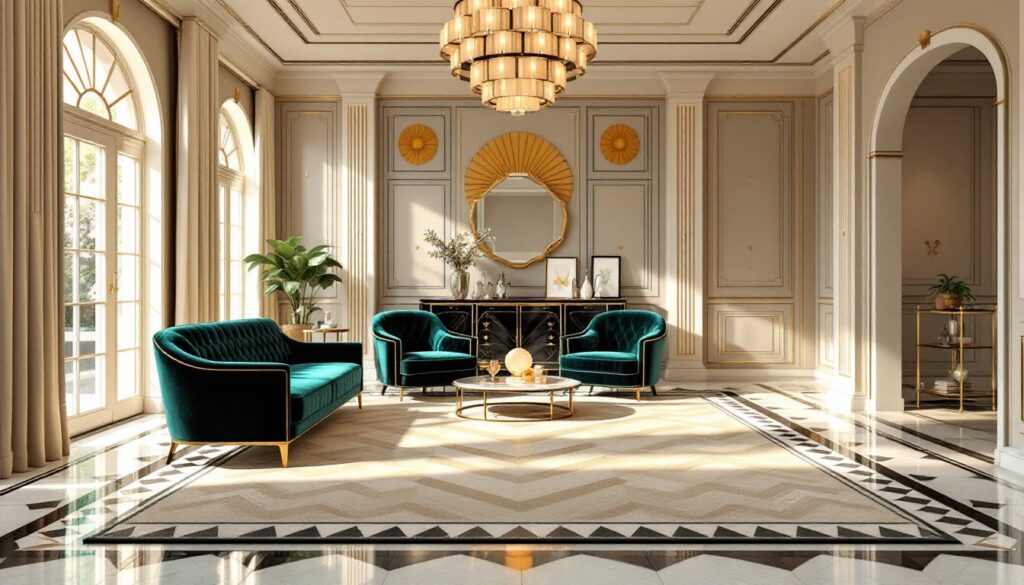
Art Deco swept through American homes in the 1920s and 1930s like a jazz riff, bold, precise, and unapologetically glamorous. Born from the 1925 Exposition Internationale des Arts Décoratifs et Industriels Modernes in Paris, this design movement married modern craftsmanship with luxurious materials, geometric precision, and a confident rejection of Victorian excess. Unlike the organic curves of Art Nouveau that preceded it, Art Deco celebrated the Machine Age with streamlined forms, symmetrical patterns, and metallic shimmer. Today’s homeowners revive these characteristics not as museum pieces, but as livable drama, whether they’re renovating a historic apartment or layering vintage flair into a modern space.
Key Takeaways
- Art Deco interior design combines geometric precision, metallic finishes, and luxurious materials to create bold, glamorous spaces that dominated 1920–1940 design.
- Incorporate Art Deco characteristics through strategic choices like geometric tile patterns, high-gloss black paint, and metallic accents rather than requiring costly custom millwork.
- Signature patterns include chevrons, sunbursts, and stepped forms that must be mathematically balanced and applied to flooring, walls, textiles, and architectural details.
- Rich jewel-tone color palettes paired with metallics (emerald, sapphire, ruby) or high-contrast monochrome schemes define authentic Art Deco aesthetics.
- Streamlined furniture silhouettes featuring waterfall edges, stepped profiles, and sculptural accessories—combined with proper lighting and bold hardware—complete the immersive Art Deco experience.
- Quality execution matters more than budget: crisp lines, uniform grout, multi-coat finishes, and proper ventilation during installation ensure the mirror-like, polished look Art Deco demands.
What Is Art Deco Interior Design?
Art Deco interior design represents a specific aesthetic that dominated roughly 1920–1940, characterized by geometric rigor, luxury materials, and optimistic modernity. It emerged after World War I as societies craved glamour and progress, reflecting industrial innovation through design. The style draws from multiple sources: ancient Egyptian motifs (amplified by the 1922 discovery of King Tut’s tomb), Cubist art, the Bauhaus movement, and even Mayan stepped pyramids.
Key identifiers include symmetrical layouts, chevron and sunburst patterns, chrome and mirror surfaces, and rich woods like zebrawood or macassar ebony. Art Deco differs sharply from mid-century modern, it’s more ornamental, more vertical, and far more willing to show off. Where mid-century favors understated function, Art Deco demands attention.
Homeowners pursuing authentic Art Deco interiors should recognize this isn’t a DIY-friendly style in the traditional sense. Many signature elements, custom millwork, inlaid floors, etched glass panels, require skilled craftspeople or salvaged architectural elements. But, strategic material choices and pattern work can capture the spirit without a gut renovation or a Hollywood budget.
Bold Geometric Patterns and Shapes
Geometry drives every Art Deco surface. Expect chevrons (zigzags), sunbursts, stepped forms, overlapping circles, and stylized florals rendered in hard-edged symmetry. These aren’t random, they’re deliberate, mathematically balanced, and often echo architectural details found in skyscrapers like New York’s Chrysler Building.
Where to Apply Geometric Patterns
- Flooring: Tile layouts in black-and-white checkerboards, hexagons, or Greek key borders. Hardwood parquet in herringbone or chevron patterns also fits, though true Art Deco often used exotic inlays.
- Wall treatments: Wallpaper with metallic geometric prints, or painted accent walls featuring stenciled patterns. Avoid busy, all-over prints, Art Deco prefers contained, repeating motifs.
- Textiles: Upholstery, area rugs, and drapery in bold geometrics. Velvet or silk fabrics amplify the effect.
- Architectural details: Crown molding with stepped profiles, door casings with angular corner blocks, or ceiling coffers in rectangular grids.
When installing patterned tile floors, ensure the substrate is dead flat, lippage (uneven tile edges) ruins the crisp look. Use a self-leveling compound if needed and a ¼-inch notched trowel for thin-set to keep grout lines tight and uniform. Large-format tiles (12×12 inches or bigger) speed installation but require laser levels for alignment.
Safety note: Cutting geometric tile patterns generates silica dust. Wear an N95 respirator and use wet-cutting methods whenever possible.
Luxurious Materials and Metallic Finishes
Art Deco interiors flaunt material wealth, or at least the convincing illusion of it. The era celebrated industrial progress, so metals weren’t hidden: they were polished and spotlighted. Chrome, nickel, brass, and stainless steel appear on hardware, light fixtures, furniture frames, and inlays. Mirrors multiply light and space, often beveled or etched with geometric designs.
Wood choices leaned exotic: macassar ebony (dark with dramatic striping), zebrawood, burled walnut, and high-gloss lacquers in black or deep jewel tones. Modern DIYers can substitute with book-matched veneer panels or high-quality laminates that mimic the grain, far cheaper and more sustainable than importing endangered hardwoods.
Material Substitutions That Work
- Instead of solid brass, use PVD-coated fixtures (physical vapor deposition) that resist tarnish and cost less.
- Swap ebony for stained oak or maple with a high-gloss polyurethane finish (three coats minimum, wet-sanded between coats with 320-grit).
- Use large mirror tiles (12×12 inches) on accent walls instead of custom beveled panels, install with mirror mastic adhesive, not construction adhesive, to avoid edge corrosion.
- Terrazzo-look porcelain tiles mimic the classic Art Deco floors found in lobbies without the weight or cost of real terrazzo.
Caution: When cutting or sanding lacquered wood or MDF, wear a respirator rated for VOCs and work in a ventilated area. Finish sanding produces fine particles that linger in the air for hours.
Rich Color Palettes and Dramatic Contrasts
Art Deco color schemes fall into two camps: high-contrast monochrome (think black, white, silver, and cream) or saturated jewel tones paired with metallics. Popular accent colors include emerald green, sapphire blue, ruby red, deep purple, and burnt orange. Backgrounds often stay neutral, dove gray, taupe, or ivory, to let bold furnishings and fixtures pop.
Black lacquer or matte black paint serves as a signature anchor. When painting trim or built-ins in high-gloss black, prep is everything. Sand to 220-grit, prime with a stain-blocking primer (especially over wood tannins), then apply at least two coats of alkyd or waterborne enamel. Each coat needs 24 hours to cure before light sanding with 320-grit. Skipping this step leaves brush marks and ruins the mirror-like finish Art Deco demands.
Color Application Tips
- Use painter’s tape with edge-lock technology for crisp lines between contrasting colors.
- Apply metallic paints (gold, silver, copper) with a foam roller to avoid brush streaks. Two thin coats beat one thick coat.
- For jewel-tone accent walls, sample colors in both natural and artificial light, Art Deco interiors often feature dramatic lighting that shifts color perception.
- Don’t forget ceilings. A glossy cream or metallic champagne ceiling reflects light and adds height, a classic Deco trick.
Paint coverage averages 350–400 square feet per gallon for quality latex, less for metallics or high-gloss finishes. Always buy extra for touch-ups.
Streamlined Furniture and Architectural Details
Art Deco furniture favors clean silhouettes over ornament, but “clean” doesn’t mean plain. Pieces feature curved fronts, stepped profiles, inlaid details, and cantilevers that showcase engineering. Upholstered seating sits low and wide, often with tufted backs or channel stitching. Wood case goods (dressers, sideboards, cabinets) sport waterfall edges, where veneer wraps continuously over rounded corners.
Architectural details telegraph the style just as loudly. Look for fluted pilasters, stepped moldings, corner blocks with angular reliefs, and transom windows with geometric grilles. Door hardware runs to substantial backplates in polished metal with angular or sunburst motifs.
DIY-Friendly Furniture Updates
- Replace generic drawer pulls with Art Deco-style bar pulls or ring pulls in brushed nickel or brass. Measure existing hole spacing (center-to-center) before ordering.
- Add a waterfall edge to a plain table by laminating a thin hardwood strip over the edge and rounding it with a router and 1/4-inch roundover bit. Sand to 220-grit and finish with high-gloss poly.
- Reupholster a vintage chair in velvet or faux leather with geometric piping. Use a staple gun (not a brad nailer) and pull fabric taut to avoid puckering.
- Install stepped baseboards by stacking a narrower cap molding atop standard base, painted in contrasting colors (e.g., black base, cream cap).
Permit check: Structural changes to walls, windows, or load-bearing elements require permits in most jurisdictions. Cosmetic updates like paint, hardware, and furniture typically don’t.
Ornamental Accessories and Artistic Elements
Art Deco accessories lean sculptural and theatrical. Expect stepped mirrors, sunburst clocks, chrome and glass bar carts, geometric vases, and Tiffany-style or frosted glass lighting. Artwork often features stylized human figures, animals (especially greyhounds and gazelles), or abstracted cityscapes in bold, flat colors.
Lighting deserves special attention, it’s both functional and sculptural. Sconces with frosted glass shades and chrome or brass arms, chandeliers with tiered geometric frames, and torchieres with upward-casting light all fit. Bulbs should be warm white (2700–3000K) to complement metallics without harsh glare.
Sourcing and Installing Accessories
- Hunt architectural salvage yards for original Art Deco light fixtures, mirrors, and hardware. Test all electrical components before installation.
- Reproduction fixtures are widely available, look for solid metal construction, not plastic painted to look like chrome.
- When hanging heavy mirrors or artwork, use toggle bolts or screw-in anchors rated for the weight if hitting studs isn’t possible. Drywall alone won’t hold a 30-pound beveled mirror.
- Display accessories in odd-number groupings (3 or 5 items) on mantels or shelves, maintaining symmetry.
- Bar carts and trolleys should roll smoothly, lubricate wheels with silicone spray, not WD-40, which attracts dust.
Safety reminder: When rewiring vintage light fixtures, hire a licensed electrician unless you’re comfortable working with 120V wiring and understand local NEC (National Electrical Code) requirements. Improper wiring causes house fires.
Conclusion
Art Deco interior design thrives on controlled drama, geometry, metallics, rich color, and streamlined form working in lockstep. Homeowners don’t need original 1920s architecture to adopt these characteristics: strategic choices in tile, paint, hardware, and lighting bring the style into any space. Focus on quality materials, crisp execution, and symmetry. The result isn’t a museum, it’s a livable nod to an era that believed progress should look as good as it functions.