
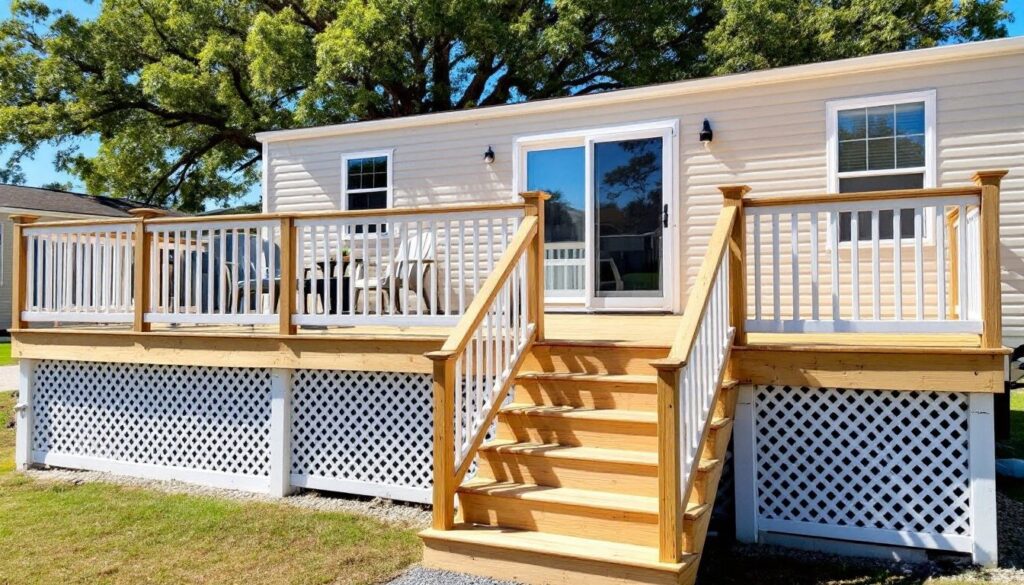
Mobile homes deserve functional, attractive outdoor spaces just as much as traditional houses, but they come with unique challenges. The structure isn’t built on a permanent foundation, weight distribution matters, and local zoning often has specific requirements for attachments. A well-designed deck can boost curb appeal, expand living space, and increase property value, but it requires careful planning around the home’s construction and local codes. Whether a homeowner wants a simple ground-level platform or a wraparound entertaining space, understanding mobile home-specific design considerations prevents costly mistakes and ensures a deck that lasts for years.
Key Takeaways
- Mobile homes require specialized deck ideas that avoid rigid attachment to the home’s frame, instead using floating designs or flexible ledger board connections to accommodate independent movement between the structure and the earth.
- Ground-level deck ideas for mobile homes are simpler to build and often require no permits, making them ideal for homeowners looking to add accessible outdoor space without complex framing or railing requirements.
- Elevated decks require independent post-and-beam foundations with concrete footings extending below the frost line, preventing weight from overloading the mobile home’s chassis and piers.
- Permit requirements and zoning regulations vary significantly by municipality—always check local building codes before starting your mobile home deck project to avoid costly do-overs.
- Pressure-treated lumber costs $800–$1,200 for a 12×16-foot ground-level deck, while composite materials run $1,800–$2,800 but offer 25–30 years of maintenance-free use compared to 15–20 years for treated wood.
- DIY construction can save $4,000–$7,000 compared to hiring contractors, which charge $25–$45 per square foot, making deck building an achievable weekend project for homeowners with intermediate carpentry skills.
Why Mobile Homes Need Specialized Deck Designs
Mobile homes sit on chassis and piers rather than traditional foundations, which changes how decks attach and bear weight. Most municipalities prohibit rigidly attaching a deck directly to a mobile home’s frame, the home can shift slightly with temperature changes and ground movement, while a deck anchored to the earth stays put. This differential movement can damage both structures.
Instead, builders typically use a floating deck design or a ledger board attachment with flexible connections that allow independent movement. Some jurisdictions require decks to be completely freestanding, positioned close to the doorway but not fastened to the home itself.
Permit requirements vary widely. Many areas require permits for decks over 30 inches in height or those exceeding a certain square footage (often 200 square feet). Some localities treat mobile home decks differently than stick-built home additions. Homeowners should check with their local building department before purchasing materials, this step prevents expensive do-overs.
Weight is another consideration. While a properly designed deck won’t overload a mobile home, connection points must distribute loads appropriately. Using lag bolts into the home’s main frame members (not just siding or rim joists) is essential if attachment is allowed. An engineer’s stamp may be required for elevated decks or complex designs.
Ground-Level Deck Ideas for Easy Access
Ground-level decks work beautifully for mobile homes with minimal height above grade. They’re simpler to build, often don’t require permits (verify locally), and eliminate the need for railings and stairs.
A floating deck sits on concrete pier blocks or poured footings without attaching to the home. Builders construct a frame using 2×6 or 2×8 treated lumber for joists spaced 16 inches on center, then lay decking perpendicular to the joists. This design works well when the door threshold is 18 inches or less from the ground.
For homes with skirting, a ground-level deck can integrate a removable access panel for ventilation and utility access, a common requirement that DIYers sometimes overlook. The deck should be built with enough clearance (typically 1-2 inches) from the skirting to prevent moisture trapping and allow for expansion.
Paver patios combined with a small raised platform offer another low-cost option. A 12×12-foot paver section creates an outdoor room, while a 6×8-foot wood platform directly at the door provides a stable transition. This hybrid approach costs less than a full wood deck and simplifies drainage.
Proper ground prep prevents settling and weed growth. Remove sod, lay landscape fabric, add 2-4 inches of compacted gravel, and ensure the site slopes away from the home at ¼ inch per foot minimum. Skipping this step leads to uneven decking and pooling water within a season.
Elevated Deck Designs for Mobile Homes
When a mobile home sits 3 feet or more off the ground, an elevated deck makes entry practical and adds valuable outdoor square footage. These require more robust construction and almost always need permits.
The deck’s support comes from its own post-and-beam foundation, independent of the mobile home. Posts (typically 4×4 or 6×6 treated lumber) rest on concrete footings that extend below the frost line, 36 inches deep in many northern zones, 12 inches in frost-free areas. A structural beam spans between posts, and joists run perpendicular, supporting the decking. This system carries all the deck’s weight without loading the mobile home frame.
Connection to the home uses a ledger board, a treated 2×8 or 2×10 bolted horizontally to provide joist attachment. For mobile homes, this board must fasten into the main I-beam or substantial frame members, never just the exterior wall. Some builders use a standoff system with metal connectors that allows slight independent movement while supporting joist ends.
Railings become mandatory when the deck surface exceeds 30 inches above grade (24 inches in some jurisdictions). Rails must be 36-42 inches tall with balusters spaced no more than 4 inches apart to prevent small children from slipping through. Composite or metal balusters require less maintenance than wood spindles.
Wraparound Decks for Maximum Space
A wraparound extends along two or more sides of the mobile home, creating distinct zones for dining, lounging, and entry. This design maximizes usable square footage on smaller lots and provides multiple access points.
Framing a wraparound requires careful joist layout. Builders typically run joists from the ledger board (or standoff beam) out to a perimeter beam supported by posts. Blocking, short pieces of lumber installed between joists, adds rigidity and prevents joist twisting, especially important on longer spans.
Corners demand attention. The framing transitions from one direction to another, requiring doubled joists or a corner post with beams running both directions. Decking boards should change direction at corners or major transitions to improve aesthetics and structural clarity.
For a 14×70-foot mobile home, a wraparound might include an 8×10-foot front entry section, a 12×14-foot side dining area, and a 6-foot-wide walkway connecting them, roughly 250 square feet total. This size fits most budgets while delivering substantial lifestyle improvement.
Budget-Friendly Materials and Construction Options
Material choice dramatically affects both upfront cost and long-term maintenance. A 12×16-foot deck requires roughly 300 square feet of decking (accounting for waste), plus framing lumber, fasteners, and concrete.
Pressure-treated pine remains the most economical choice. Expect to pay $2-3 per linear foot for 5/4×6 decking boards (actual dimensions: 1 inch × 5.5 inches) in 2026. A complete ground-level deck might run $800-1,200 in materials. Treated lumber lasts 15-20 years with occasional staining or sealing. It requires ACQ-rated fasteners (galvanized or coated screws) because the copper-based preservatives corrode standard steel.
Composite decking costs $4-8 per linear foot but eliminates rot, splintering, and annual maintenance. It’s heavier than wood, so joist spacing may need to tighten to 12 inches on center depending on the product, check manufacturer specs. The total material cost jumps to $1,800-2,800 for the same deck size, but there’s no staining or sealing labor over the deck’s 25-30 year lifespan.
Cedar splits the difference at $3-5 per linear foot. It resists rot naturally, looks beautiful, and weighs less than composites. It will weather to gray without finish, or homeowners can apply a clear sealer every 2-3 years to maintain color.
Foundation options also affect budget. Concrete pier blocks ($8-12 each) sit on tamped gravel and work for ground-level floating decks. Poured footings ($15-25 each in materials) provide better stability for elevated decks and are required by most codes for structures over 30 inches high. A 12×16 elevated deck needs 6-8 footings.
DIY labor saves substantial money. Hiring a contractor typically costs $25-45 per square foot installed, so a 192-square-foot deck runs $4,800-8,640. Building it yourself drops the cost to materials only, a savings of $4,000-7,000. The project requires intermediate carpentry skills, a circular saw or miter saw, a drill, a level, and a post-hole digger or rented auger.
Adding Features to Enhance Your Mobile Home Deck
Functional additions transform a basic deck into a true outdoor living area without breaking the budget.
Built-in benches use the same decking material and eliminate the need for furniture. A simple design uses 2×4 framing with a 2×12 or doubled 2×6 seat at 18 inches high. Add a backrest at a 10-15 degree angle for comfort. Benches also serve as railings when built to proper height (36-42 inches) along the deck’s edge.
Lattice skirting conceals the area under elevated decks, improves appearance, and provides ventilation. Use pressure-treated lattice panels in a wood or vinyl frame attached to the posts. Include a hinged access panel for storage or utility access, propane tanks, garden tools, and pool equipment tuck neatly underneath.
Pergolas and shade structures extend usability during hot months. A simple pergola uses 2×6 or 2×8 rafters spanning between posts, with 2×2 or 2×4 cross pieces spaced 12-16 inches apart on top. This provides dappled shade and supports climbing plants or retractable fabric shades. Secure pergola posts to the deck framing or mount them to the same footings that support the deck, don’t rely on deck boards to carry the vertical load.
Lighting improves safety and ambiance. Solar post cap lights require no wiring and cost $15-30 each. For permanent solutions, low-voltage LED systems run on a transformer ($50-100) with wire buried under the deck. Fixtures mount on posts, along stairs, or under railings. Always use outdoor-rated fixtures and wire, interior products fail quickly in weather.
Privacy screens create enclosure without walls. Vertical 1×4 or 1×6 boards spaced 2-4 inches apart attach to a 2×4 frame mounted to deck posts. Alternating the boards on both sides of the frame creates a shadowbox effect that blocks sightlines while allowing airflow. This costs roughly $60-100 per 8-foot section in materials.
All additions should account for wind load and local codes. Post-to-beam connections need hurricane ties or through-bolts, not just nails. Safety equipment for installation includes safety glasses, work gloves, and ear protection when using power saws.
Conclusion
A well-planned deck turns a mobile home’s outdoor space into a functional extension of the living area. Success comes from understanding the unique attachment requirements, choosing appropriate materials for the budget and climate, and following local codes. Whether building a simple ground-level platform or a wraparound entertaining deck, careful planning and quality construction deliver years of use and improved property value.