
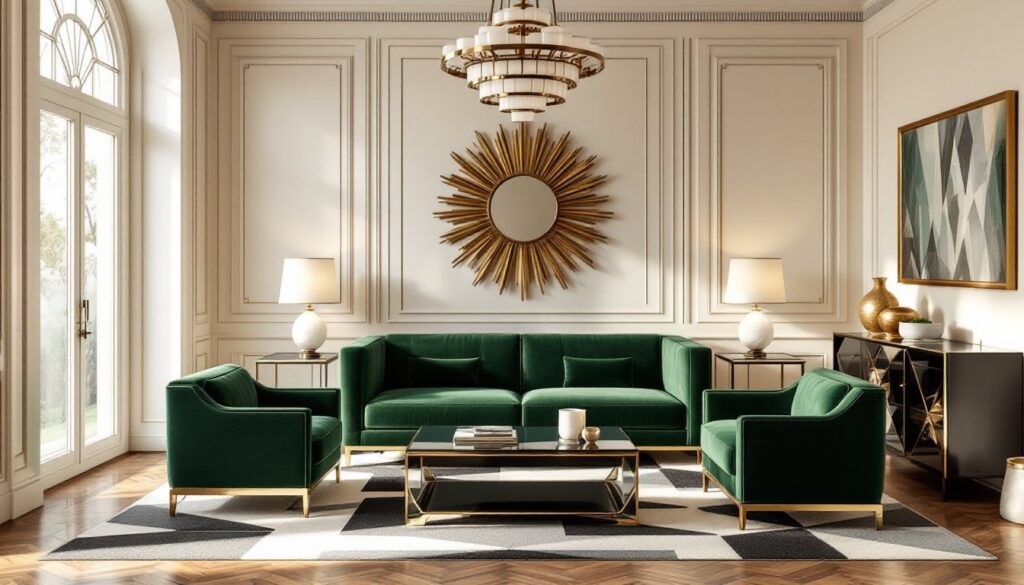
Art Deco isn’t just a design style, it’s a statement. Born in the roaring 1920s and hitting its stride through the 1930s, this aesthetic married luxury with geometry, creating spaces that felt both opulent and modern. While most design trends fade, Art Deco has staying power. Its bold lines, metallic finishes, and unapologetic glamour still turn heads nearly a century later. For homeowners looking to inject drama and sophistication into their interiors without veering into stuffy formality, Art Deco delivers. This guide breaks down the essentials, what defines the style, how to execute it room by room, and the color choices that make it work in 2026.
Key Takeaways
- Art Deco style interior design thrives on bold geometric patterns, luxurious metallic finishes, and high-contrast color schemes that create opulent, sophisticated spaces without stuffy formality.
- Start with a single focal point per room—such as a statement light fixture, geometric wallpaper accent wall, or bold area rug—to anchor Art Deco without overwhelming your space.
- Material quality matters: layer mirrored surfaces with velvet upholstery, pair high-gloss lacquer with brushed brass, and choose durable engineered hardwood in chevron patterns to achieve authentic impact.
- Art Deco color palettes combine jewel tones (emerald, sapphire, ruby) with cream or ivory neutrals, or opt for classic black-and-white with metallic accents—always maintaining the 60-30-10 color balance rule.
- Success requires commitment: half-executed Art Deco reads as confused rather than glamorous, so invest in period-appropriate details like parquet flooring, symmetrical lighting pairs, and curated accessories.
What Is Art Deco Interior Design?
Art Deco emerged between World Wars as a reaction to the austerity of earlier movements and the organic curves of Art Nouveau. It celebrated industrialization, symmetry, and bold ornamentation. Think Chrysler Building spires, Gatsby-era cocktail bars, and streamlined ocean liners.
The style borrows motifs from ancient cultures, Egyptian ziggurats, Aztec step pyramids, African tribal art, but filters them through a modern, geometric lens. Unlike minimalism, Art Deco doesn’t shy away from decoration. Instead, it leans into pattern, contrast, and high-gloss finishes.
In practical terms, Art Deco interiors rely on symmetry, layered lighting, and high-contrast materials. A typical room might feature a sunburst mirror over a lacquered console, flanked by matching sconces with frosted glass shades. Floors often showcase parquet in chevron or herringbone patterns. Wall treatments range from geometric wallpaper to stepped molding profiles that echo skyscraper setbacks.
It’s not a style that works on a shoestring budget or with halfway measures. Successful Art Deco spaces require commitment, both in material selection and in maintaining visual balance. Half-executed attempts tend to read as confused rather than glamorous.
Key Characteristics of Art Deco Style
Geometric Patterns and Bold Lines
Art Deco trades curves for angles. Chevrons, zigzags, sunbursts, and stepped forms dominate the visual language. These show up in everything from tile work to furniture silhouettes.
For flooring, consider engineered hardwood in chevron or herringbone layouts. Standard 3/4-inch solid oak works too, but engineered planks (typically 5/16 to 1/2 inch thick) offer better dimensional stability in climates with humidity swings. Parquet borders in contrasting woods, walnut inlaid into maple, for instance, add period-appropriate detailing without custom millwork costs.
Wall treatments benefit from geometry. Removable peel-and-stick wallpaper in Art Deco patterns runs $1.50 to $4 per square foot and installs without the commitment of traditional paste. For a more permanent approach, use 1×4 or 1×6 pine boards (actual dimensions: 3/4″ × 3.5″ and 3/4″ × 5.5″) to create picture-frame molding in geometric arrangements. Paint the recessed panels in a contrasting shade for depth.
Furniture should echo the angular theme. Low-profile platform beds, waterfall-edge dressers, and club chairs with squared arms all fit. Avoid anything overstuffed or fussy, Art Deco silhouettes are clean and deliberate.
Luxurious Materials and Metallic Accents
Art Deco thrives on material contrast. Pair high-gloss lacquer with brushed brass, mirrored surfaces with exotic veneers, velvet upholstery with chrome hardware. The interplay of matte and shine creates visual interest.
Metallic finishes are non-negotiable. Brass, gold, chrome, and nickel appear in lighting fixtures, cabinet pulls, mirror frames, and table bases. For hardware, polished brass requires regular maintenance to prevent tarnish, while PVD-coated brass (physical vapor deposition) offers similar warmth with better durability. Brushed nickel and satin chrome work for homeowners wanting lower upkeep.
Mirror plays a dual role: it amplifies light and reinforces the era’s love of reflective surfaces. Antiqued mirror tiles (typically 12×12 inches or 6×12 inches) install with construction adhesive and create feature walls without the weight of a single large pane. Grout lines should be minimal, use 1/16-inch spacing and metallic or black grout to maintain crisp geometry.
For countertops and tabletops, quartz with veining mimics the marble popular in original Art Deco spaces but performs better against stains and etching. Standard slab thickness is 3 cm (roughly 1.25 inches): 2 cm works for vertical applications or lighter-use surfaces. Waterfall edges, where the material continues down the side, echo the style’s streamlined aesthetic.
Velvet and leather upholstery anchor seating. Velvet’s pile catches light and shifts tone depending on viewing angle, adding depth. Choose 100% polyester velvet for high-traffic areas: it wears better than cotton-blend options and resists crushing. Top-grain leather in jewel tones or classic black works for dining chairs and accent pieces.
How to Incorporate Art Deco into Your Home
Start with a focal point. Art Deco doesn’t do subtlety, so choose one element per room to carry the style’s weight, a statement light fixture, a bold wallpaper accent wall, or a geometric area rug.
For lighting, tiered chandeliers and sconces with frosted or etched glass fit the era. Modern reproductions are widely available: look for fixtures with stepped profiles or fan motifs. If rewiring isn’t in the budget, battery-powered LED sconces with remote controls mimic the look without cutting into walls. Just ensure the mounting height and spacing maintain symmetry, Art Deco lighting works in pairs or centered arrangements.
Wall treatments set the tone. Geometric wallpaper in metallic inks gives instant impact. Application is straightforward: prep walls smooth (fill nail holes, sand glossy paint with 120-grit sandpaper for better adhesion), cut paper with a 2-inch overlap for pattern matching, and use a smoothing tool to eliminate bubbles. Coverage averages 30 square feet per single roll, so measure carefully.
Alternatively, paint can achieve Art Deco geometry. Use painter’s tape (FrogTape or 3M ScotchBlue, which seal better than generic brands) to mask stepped or chevron patterns. Apply a base coat, let it cure 24 hours, tape off the design, then paint the accent color. Remove tape while the paint is still slightly tacky to avoid peeling.
Furniture doesn’t need to be vintage. Replicas and contemporary pieces with Art Deco influence are easier to source and often more durable. Look for low-slung profiles, tapered legs, mirrored or lacquered finishes, and geometric inlays. A waterfall-edge credenza or barrel-back velvet chairs integrate smoothly.
Accessories complete the look. Sunburst mirrors (available in diameters from 24 to 48 inches) add drama above mantels or console tables. Geometric vases in ceramic or glass, bar carts with brass frames and glass shelves, and abstract art prints with angular compositions all reinforce the theme. Avoid clutter, Art Deco thrives on curated displays, not crowded surfaces.
For flooring transitions, if existing floors don’t fit the aesthetic, area rugs in bold geometric patterns bridge the gap without the cost of refinishing or replacement. Choose wool or wool-blend rugs for durability: 8×10 or 9×12 sizes anchor furniture groupings in living and dining spaces.
Art Deco Color Palettes That Make a Statement
Art Deco color schemes lean into high contrast and jewel tones. The classic combination pairs black and white with a metallic accent, gold, silver, or brass. This works especially well in bathrooms and entryways where material choices (tile, fixtures, mirrors) naturally incorporate metallics.
For richer palettes, emerald green, sapphire blue, ruby red, and amethyst purple evoke the era’s opulence. Pair these with cream, ivory, or champagne neutrals to avoid overwhelming the space. A living room might feature navy walls, cream molding, and brass lighting, with emerald velvet seating as the accent.
Muted metallics also belong. Rose gold, brushed brass, and gunmetal gray read as sophisticated rather than flashy. These work in kitchens and bedrooms where full-on glitz feels too aggressive.
Paint finish matters. High-gloss or semi-gloss on trim and accent walls mimics the lacquered surfaces original to the style. Most manufacturers offer enamel paints specifically for trim: these cure harder and resist chipping better than standard latex. Expect coverage of 350-400 square feet per gallon for quality trim paint, though dark colors often require a second coat.
Accent walls in bold colors anchor a room without total commitment. Use painter’s tape to ensure crisp lines where the accent wall meets adjacent surfaces. For the cleanest edge, run a thin bead of the base wall color along the tape seam before applying the accent color, this seals any gaps and prevents bleed-through.
When combining colors, stick to a 60-30-10 rule: 60% dominant color (walls, large furniture), 30% secondary color (upholstery, rugs), and 10% accent color (pillows, art, accessories). This maintains balance and prevents the space from reading as chaotic.
Conclusion
Art Deco isn’t for everyone, and that’s part of its appeal. It demands intention, careful material selection, disciplined symmetry, and a willingness to go bold. But for homeowners ready to commit, it delivers rooms with presence and personality that stand apart from the sea of gray farmhouse interiors. The key is balance: mix vintage-inspired elements with modern durability, embrace geometry without letting it overwhelm function, and choose metallics that enhance rather than compete. Done right, Art Deco transforms a house into a showpiece, one that’s been turning heads for a century and shows no signs of stopping.