
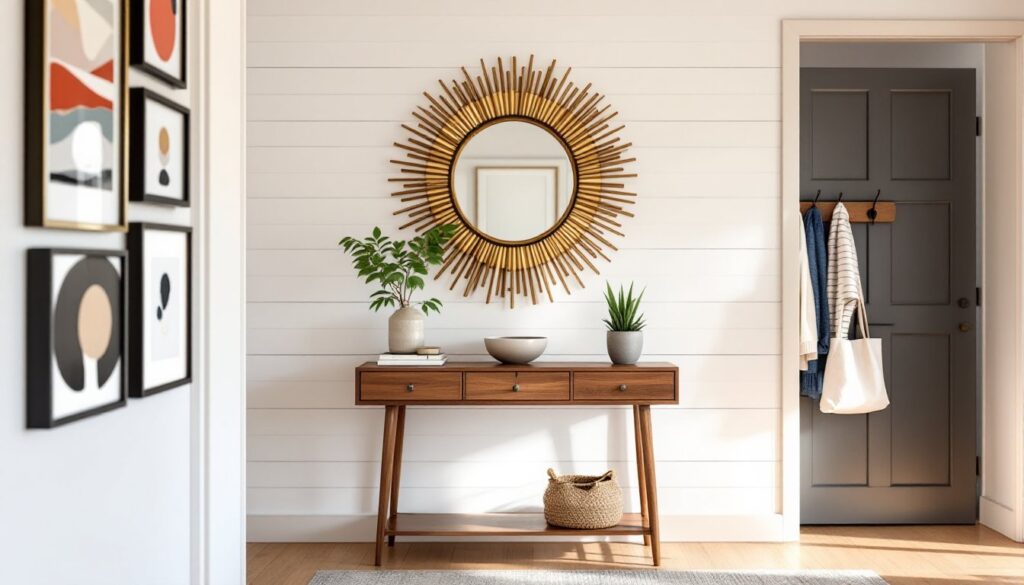
The foyer is the first interior space guests see, yet it’s often the last to get decorating attention. That’s a missed opportunity. A well-designed entryway sets the tone for the entire home, and the walls are prime real estate for making that statement. Unlike high-traffic living areas, foyer walls don’t face the same wear demands, which opens up creative possibilities, from delicate wallpapers to oversized art. The challenge lies in balancing visual impact with function, especially in compact entries where every square foot counts. This guide walks through practical, achievable wall decor strategies that work for tight condo foyers and sprawling two-story entries alike.
Key Takeaways
- Foyer wall decor makes a powerful first impression in just seven seconds, setting the tone for your entire home and creating visual interest without high-traffic wear demands.
- Strategic foyer wall decor serves three critical purposes: anchoring the room’s design, transitioning between exterior and interior spaces, and solving structural challenges like narrow proportions or low ceilings.
- Large-format mirrors and vertical artwork effectively amplify light and space in compact entries, while gallery walls require careful planning with 2–3 inch spacing and balanced composition to avoid visual clutter.
- Statement mirrors over 20 pounds need mirror clips or a French cleat system for secure installation, and should be positioned 4–6 inches above console tables or 30 inches from the floor.
- Modern peel-and-stick wallpaper and accent walls deliver dramatic foyer wall impact without permanent commitment, while board-and-batten molding adds three-dimensional texture with paint alone.
- Functional decor like wall-mounted hooks (at 60″ for adults) and floating shelves (8–12″ deep) eliminate clutter while adding visual interest, with hooks requiring stud placement or heavy-duty toggles for 50+ pound loads.
Why Foyer Wall Decor Matters More Than You Think
First impressions form in seven seconds, and the foyer is ground zero. Bare walls signal unfinished space: cluttered ones create visual chaos before visitors even remove their shoes. Strategic wall decor serves three purposes: it anchors the room’s design, provides a transition between exterior and interior aesthetics, and can solve practical problems like narrow proportions or low ceilings.
A vertical mirror or tall artwork draws the eye upward in cramped entries, while horizontal gallery arrangements widen narrow hallways. In open-plan homes where the foyer blends into living areas, wall decor helps define the entry zone without physical barriers. It’s also the easiest place to experiment with bold choices, if that emerald green accent wall doesn’t work, it affects only a small, transitional space.
The structural advantage: most foyer walls are non-load-bearing partitions, making installation straightforward. Standard drywall takes picture hangers, toggle bolts, and adhesive hooks without the complexities of tile or brick. Just verify stud locations for heavier pieces (anything over 30 pounds should hit wall studs at 16″ or 24″ on center).
Statement Mirrors That Amplify Light and Space
Mirrors are the workhorse of foyer design. A large-format mirror (36″ wide or larger) opposite a window or door bounces natural light deeper into the home, effectively doubling the perceived square footage. This works especially well in entries with a single light source.
For installation, frameless mirrors over 20 pounds require mirror clips or a French cleat system, adhesive alone won’t hold long-term. Position the bottom edge 4–6 inches above a console table or 30 inches from the floor for standalone placement. Avoid hanging mirrors directly opposite the front door in narrow foyers: the reflection of people entering can feel disorienting.
Leaner mirrors (full-length styles that rest against the wall at a slight angle) offer flexibility without drilling and work in rentals. Secure the top with earthquake putty or L-brackets to prevent tipping. Sunburst, arched, or geometric metal frames add architectural interest in minimalist spaces, while carved wood frames suit traditional interiors. The frame should contrast with wall color, a dark bronze frame disappears against charcoal walls, but pops against white shiplap.
Gallery Walls: Creating a Personal Welcome
Gallery walls let homeowners curate a narrative, but poor planning results in a cluttered mess. The key: treat the entire arrangement as one large shape, not individual pieces floating randomly.
Start by cutting paper templates matching each frame’s dimensions. Tape them to the wall, adjusting until the composition feels balanced, edges should align to form a rough rectangle or square, with 2–3 inches between frames. Common layouts include:
- Grid arrangement: Uniform frames and matting, 2″ spacing. Clean, modern, easy to plan.
- Salon-style: Mixed sizes and frames with one large anchor piece (typically center or off-center). Requires more trial and error but feels collected over time.
- Linear horizontal: 3–5 pieces in a single row, good for narrow walls flanking doorways.
Hang the center piece first at 57–60 inches (museum standard, measured to the artwork’s center), then work outward. Use a laser level for multi-piece rows, eyeballing leads to noticeable drift over 6+ feet. For drywall, picture-hanging hooks rated to each frame’s weight work for most applications: screw-in anchors are necessary for plaster walls.
Frame selection: Mix no more than three frame finishes (e.g., black, natural wood, brass) and vary orientation (portrait/landscape) for visual rhythm. White mats create breathing room and unify disparate images. Include at least one unexpected element, a small shelf, a sculptural object, or vintage find, to break predictability.
Bold Wallpaper and Accent Walls for Dramatic Impact
Wallpaper has shed its dated reputation. Modern peel-and-stick wallpaper installs without paste or professional help, making it viable for renters and commitment-phobes. Most removable wallpapers hold up for 2–3 years before edges lift, adequate for trend-driven updates.
For permanent installations, traditional paste-the-wall or pre-pasted papers offer wider pattern selection and better durability. Large-scale patterns (damasks, oversized florals, geometric murals) work in foyers because viewers see the wall from a distance while entering, unlike a bedroom where you’re inches away. A single accent wall, typically the first wall visible when opening the door, delivers impact without overwhelming small spaces.
Installation tips: Start in the least visible corner and work toward the main sightline. Use a 6-inch drywall knife or smoothing tool to eliminate bubbles, working from center outward. Cut around outlets and switches with power off at the breaker, wallpaper is non-conductive, but wet paste and metal tools near live wires aren’t worth the risk.
Alternatively, board-and-batten or picture-frame molding creates three-dimensional texture with paint alone. Install 1×4 or 1×6 boards (actual dimensions ¾” × 3½” or ¾” × 5½”) vertically at 16–24″ spacing, or as horizontal frames. Fill nail holes with spackle, caulk seams, prime, then paint the entire wall one color for subtle detail or contrast the frames for bold definition.
Functional Decor: Hooks, Shelves, and Storage Solutions
The best foyer decor works double duty. Wall-mounted coat hooks (install at 60″ for adults, 48″ for kids) eliminate clutter while adding visual interest, think cast iron schoolhouse hooks, modern brass pegs, or reclaimed wood boards with vintage hardware.
For heavier coats and bags, hooks must hit studs or use heavy-duty toggle bolts rated for 50+ pounds in ½” drywall. A row of three hooks spaced 8–10 inches apart handles a family’s daily rotation without crowding.
Floating shelves (8–12″ deep) display keys, mail, or small plants while keeping surfaces clear. Install with hidden brackets or a French cleat for a seamless look. In narrow foyers, keep shelf depth under 10″ to maintain clearance, building codes don’t dictate foyer width, but 36″ clear passage is standard for accessibility.
Pegboard systems bring workshop utility indoors when framed or painted to match decor. A 2’×4′ section holds hooks, small baskets, and mirrors in reconfigurable layouts. Mount pegboard over furring strips (1×2 boards) to create the ½” gap pegs need to insert from the front.
Combine function and art: a vintage window frame repurposed as a mail organizer, a decorative tray on the wall for keys, or magnetic paint under a finish coat to turn a section into a hidden memo board.
Choosing the Right Scale and Placement for Your Space
Scale errors are the most common DIY mistake. A 16″×20″ print floats awkwardly on an 8-foot wall: a 5-foot mirror overwhelms a narrow hallway.
The two-thirds rule: Wall decor should occupy roughly two-thirds the width of the furniture beneath it, or two-thirds the wall section if freestanding. For a 48″-wide console, aim for 30–36″ of art or a mirror grouping that wide.
Height placement depends on ceiling height and purpose:
- Standard 8-foot ceilings: Center artwork at 57–60″, measured to the piece’s center.
- Two-story foyers: Large-scale art (4–6 feet tall) works on the prominent wall, installed so the bottom third sits at eye level when entering.
- Above furniture: Leave 6–8″ between the console top and artwork bottom to visually connect them without crowding.
In narrow foyers (under 5 feet wide), avoid protruding elements. Flat art and mirrors work: deep shelves and 3D sculptures create obstacles. Vertical orientation elongates tight spaces.
Test placement before committing. Use painter’s tape to outline frames on the wall, live with it for a day, and adjust. Take photos, the camera reveals balance issues the eye misses up close. For multi-story entries, view the composition from the top of the stairs, the base, and straight-on from the doorway.
Conclusion
Foyer walls set the tone before a single word is spoken. Whether it’s a statement mirror reflecting light into a dark corridor, a gallery wall telling a family’s story, or functional hooks disguised as decor, the approach should match how the space is used. Measure twice, use proper anchors for the wall type, and don’t be afraid to go bold in a small area. The entry is the one place where dramatic choices feel intentional, not risky.